
Learn to Ship
A small agent that ranks what to study by the gap each item can help close.
Current chapter
Archived, with the work and its history preserved.
Status recorded 2026-09-14The idea
Connect learning choices to a specific outcome, with a reason that can be inspected and a ranking that can be reproduced.
My contribution
I built a deterministic ranker that reads gap data through an MCP tool, with a golden evaluation and a cloud demo using a fictional learner.
Along the way
The tool recommended building itself
Published the story of the first version: ranking study items, keeping private data separate, and shipping an end-to-end agent.
Related writing
Learning to Ship
I built an agent to tell me what to study next. Its first answer was: build this.
Full case study
Not the most interesting thing to study, the highest-leverage one.
The problem
I have far more things I could study than time to study them, and the temptation is to learn whatever is most interesting that day. For a career transition that’s a trap: the studying feels productive but doesn’t move a hiring outcome. The question I actually need answered is narrower — of everything on my list, which item unblocks the most valuable gap between me and the roles I want? That’s a ranking against real gap data, not a vibe — and the answer changes as the target roles do.
What I built
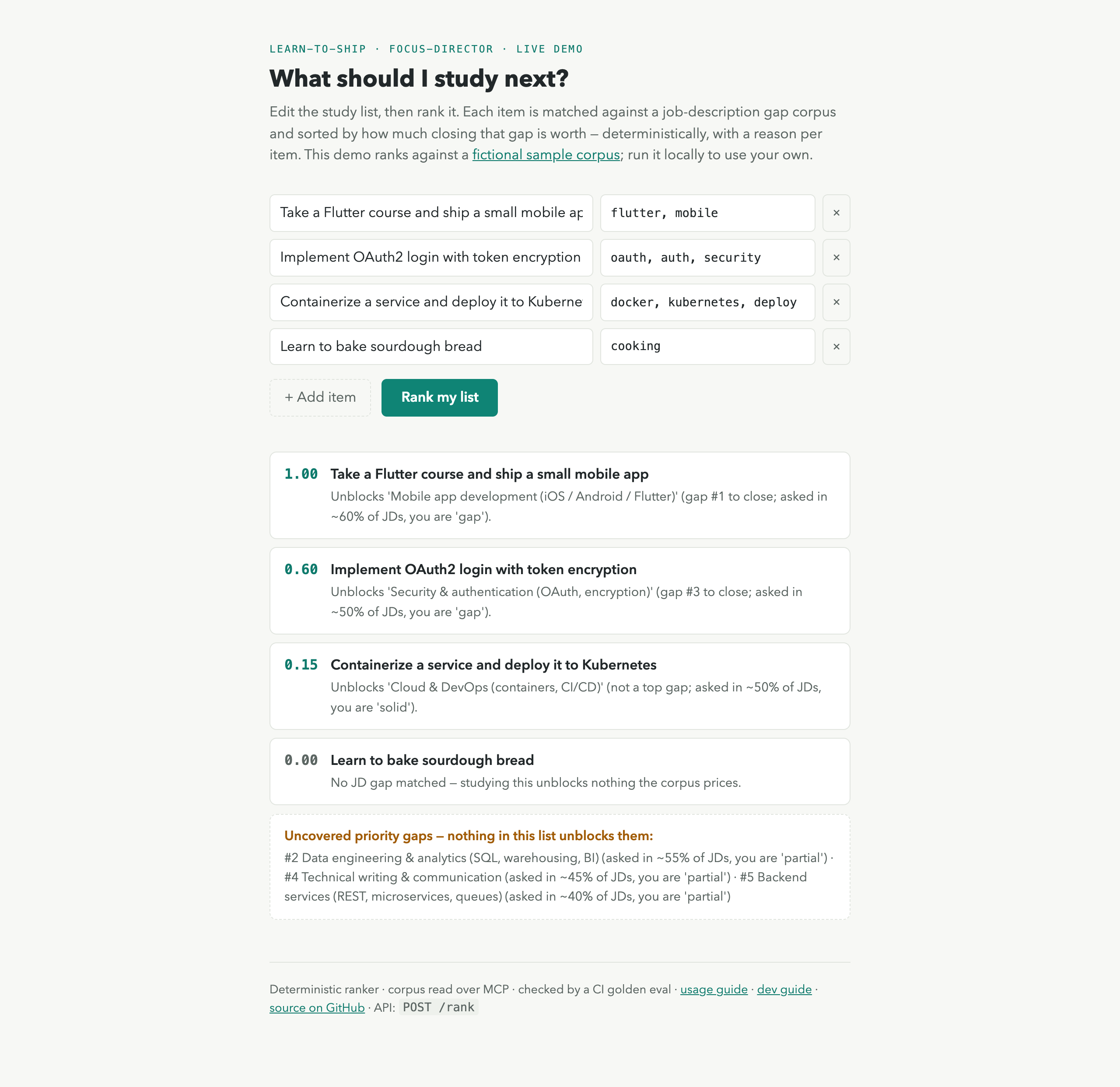
A deterministic ranker — not an LLM call. The agent matches each study item to the gap it unblocks and sorts by that gap’s closing-leverage (how often the skill is demanded × how far my current level sits below it). Same inputs → same order, every time. I ruled out an LLM ranker on purpose: a recommendation I can’t reproduce or evaluate isn’t one I’d trust to steer my own weeks — and a deterministic core is what makes the eval below hermetic.
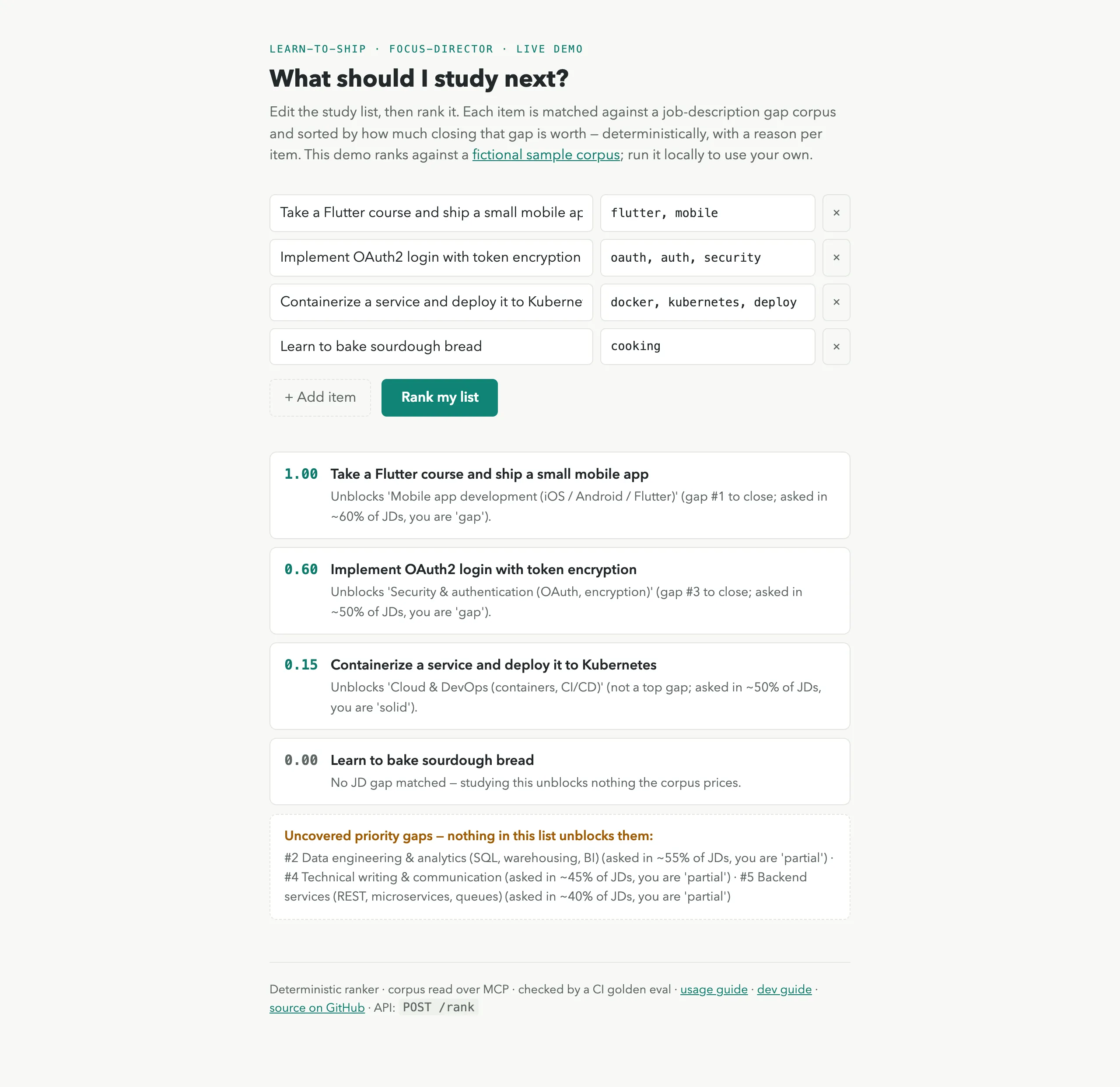
The live demo ranking a study list — a score and a reason per item, and the priority gaps nothing on the list unblocks.
The gap corpus is read through an MCP tool, never a file read. The only component that touches it is an in-repo MCP server the agent calls over a real stdio round-trip. That seam is what lets the public demo serve a fictional “Sample Learner” while my real data stays private behind the exact same tool contract.
Public agent, private data — enforced by construction. The repo is built in public; my career data never is. The committed corpus is a synthetic stub; the real one is wired in via an env override and excluded from the deployed image, and history was rewritten clean before the first push, so no private data exists in any commit.
Results
- Shipped end-to-end in a day (10 commits): a live cloud endpoint on
Hugging Face Spaces (health check +
POST /rank) behind a small FastAPI + Docker layer — deployed free, no paid LangGraph Platform. - Eval as a build gate. A golden eval pins the full ranked order; GitHub Actions runs lint + eval on every push (~18s, hermetic — no API key, no network) and a ranking regression fails the build. ~874 lines of Python behind a 25-test suite.
- Actually used. I run it on my real corpus to decide what to study — the usage evidence a “running” claim is supposed to have, not a demo that only runs when someone’s watching.
What I’d do differently
In v0 the ranker is a single deterministic node — LangGraph is doing almost nothing a plain function couldn’t, and the framework only earns its place in v1, where a second graph reviews the flashcards I write against the source. The other soft spot is the ranker itself: word-anchored keyword matching is brittle — a study item whose title doesn’t lexically overlap its gap won’t match. A semantic match would be more robust; I kept it deterministic to preserve the hermetic eval, and next I’d add a small labeled set to measure whether embeddings actually beat keywords before reaching for them.